

Block 1 (Stuart), Block 2 (Wells), Block 3 (Nelson), Block 4 (Ward), Block 5 (Brennan), Block 6 (Gregory), Block 7 (Leichhardt), and Block 8 (Chan).

Block 1: Stuart Building
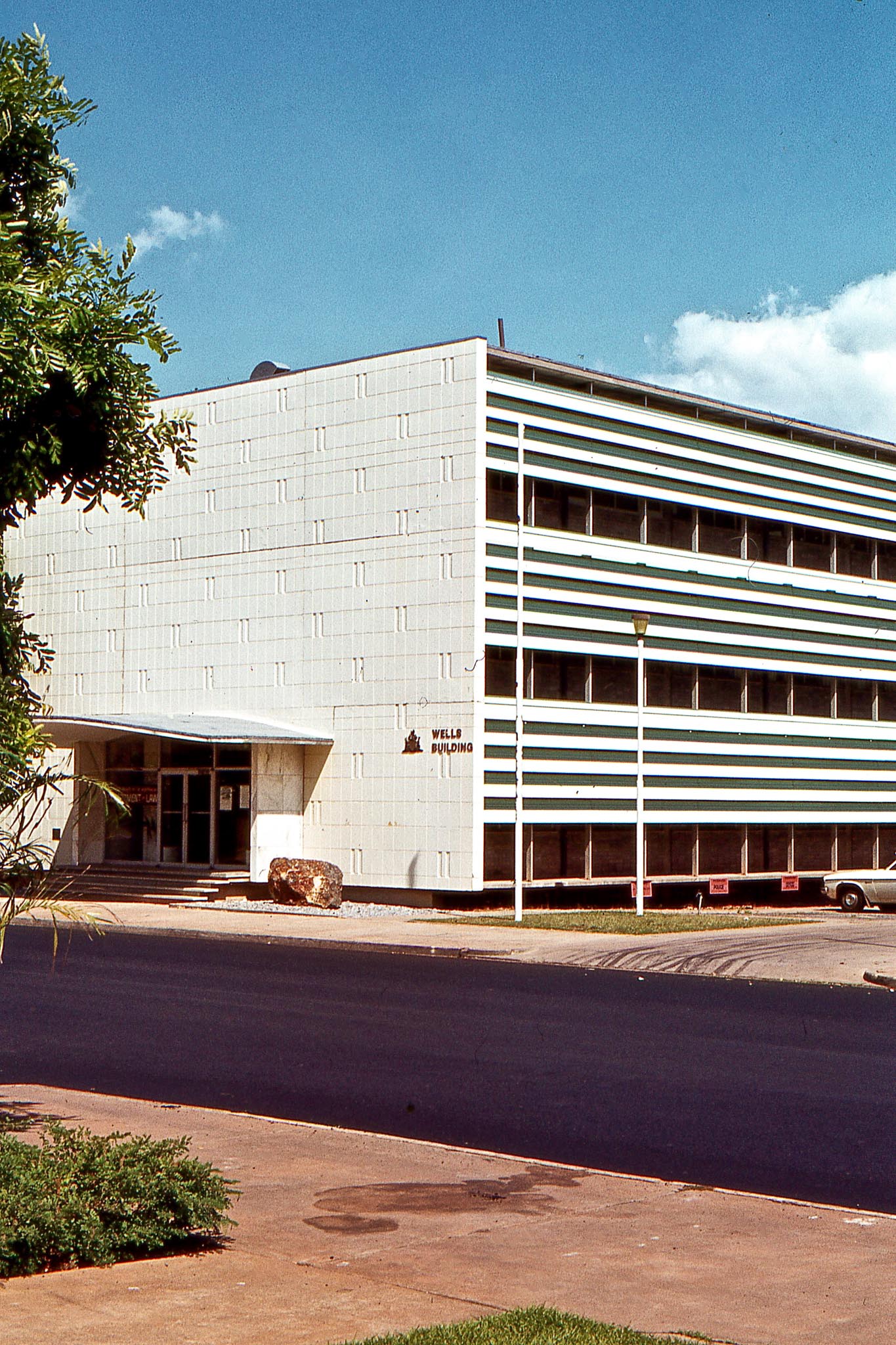
Block 2: Wells Building

Block 3: Nelson Building

Block 4: Ward Building

Block 7: Leichardt Building

Block 8: Chan Building

The view of the Admininstrative Centre along Mitchell St.

Aerial view of the Admininstrative Centre.
COMMONWEALTH ADMINISTRATIVE CENTRE
MITCHELL ST, DARWIN, NT 0800
(DEMOLISHED)
PHOTOS: FLICKR & NT INDEPENDENT
MITCHELL ST, DARWIN, NT 0800
(DEMOLISHED)
PHOTOS: FLICKR & NT INDEPENDENT
The Commonwealth Administrative Centre in Darwin represents one of the most coherent clusters of mid-century institutional architecture in the Northern Territory.
Conceived and constructed during a period of expanding government presence in the post-war decades, this precinct brought together multiple office blocks and civic buildings designed to house Commonwealth and Territory administrative functions.
Rather than isolated structures, these buildings collectively articulate a planned civic core that helped define the spatial and symbolic heart of Darwin’s emerging modern city.
Buildings within the Administrative Centre were typically arranged around a legible urban framework, prioritising clear circulation, functional zoning and the efficient accommodation of public services.
Their architectural language drew on modernist ideals, simple geometric forms, restrained material expression and rational planning, while also responding to Darwin’s tropical climate through shading, ventilation strategies and durable construction.
These qualities reflect a pragmatic application of modernism to institutional needs, where the demands of administration, accessibility and environment shaped built form.
As a precinct, the Commonwealth Administrative Centre conveys the ambitions of mid-twentieth-century governance in the Territory, where architecture was enlisted to express civic order, bureaucratic presence and public service.
It also illustrates how government-initiated development provided opportunities for architectural experimentation and workforce expansion, supported by an influx of skilled labour during a period of territorial growth.
Today, the legacy of the Administrative Centre remains visible not only in individual buildings, some of which have been repurposed over time, but also in the urban imprint of a deliberate ensemble that framed Darwin’s administrative life for decades.
The precinct stands as a reminder that modern architecture in the Northern Territory was not only about bold individual works but also about the collective shaping of civic space in response to social, political and climatic conditions.
Over time the buildings were progressively demolished to make way for the State Square:
- Liberty Square replaced Block
- Parliament House replaced Blocks 2 and 3
- The Supreme Court replaced Blocks 4 and 5
- The Supreme Court car parks replaced Blocks 6 and 7
More infomration on the Commonwealth Admininstrative Centre can be found here.
Conceived and constructed during a period of expanding government presence in the post-war decades, this precinct brought together multiple office blocks and civic buildings designed to house Commonwealth and Territory administrative functions.
Rather than isolated structures, these buildings collectively articulate a planned civic core that helped define the spatial and symbolic heart of Darwin’s emerging modern city.
Buildings within the Administrative Centre were typically arranged around a legible urban framework, prioritising clear circulation, functional zoning and the efficient accommodation of public services.
Their architectural language drew on modernist ideals, simple geometric forms, restrained material expression and rational planning, while also responding to Darwin’s tropical climate through shading, ventilation strategies and durable construction.
These qualities reflect a pragmatic application of modernism to institutional needs, where the demands of administration, accessibility and environment shaped built form.
As a precinct, the Commonwealth Administrative Centre conveys the ambitions of mid-twentieth-century governance in the Territory, where architecture was enlisted to express civic order, bureaucratic presence and public service.
It also illustrates how government-initiated development provided opportunities for architectural experimentation and workforce expansion, supported by an influx of skilled labour during a period of territorial growth.
Today, the legacy of the Administrative Centre remains visible not only in individual buildings, some of which have been repurposed over time, but also in the urban imprint of a deliberate ensemble that framed Darwin’s administrative life for decades.
The precinct stands as a reminder that modern architecture in the Northern Territory was not only about bold individual works but also about the collective shaping of civic space in response to social, political and climatic conditions.
Over time the buildings were progressively demolished to make way for the State Square:
- Liberty Square replaced Block
- Parliament House replaced Blocks 2 and 3
- The Supreme Court replaced Blocks 4 and 5
- The Supreme Court car parks replaced Blocks 6 and 7
More infomration on the Commonwealth Admininstrative Centre can be found here.