
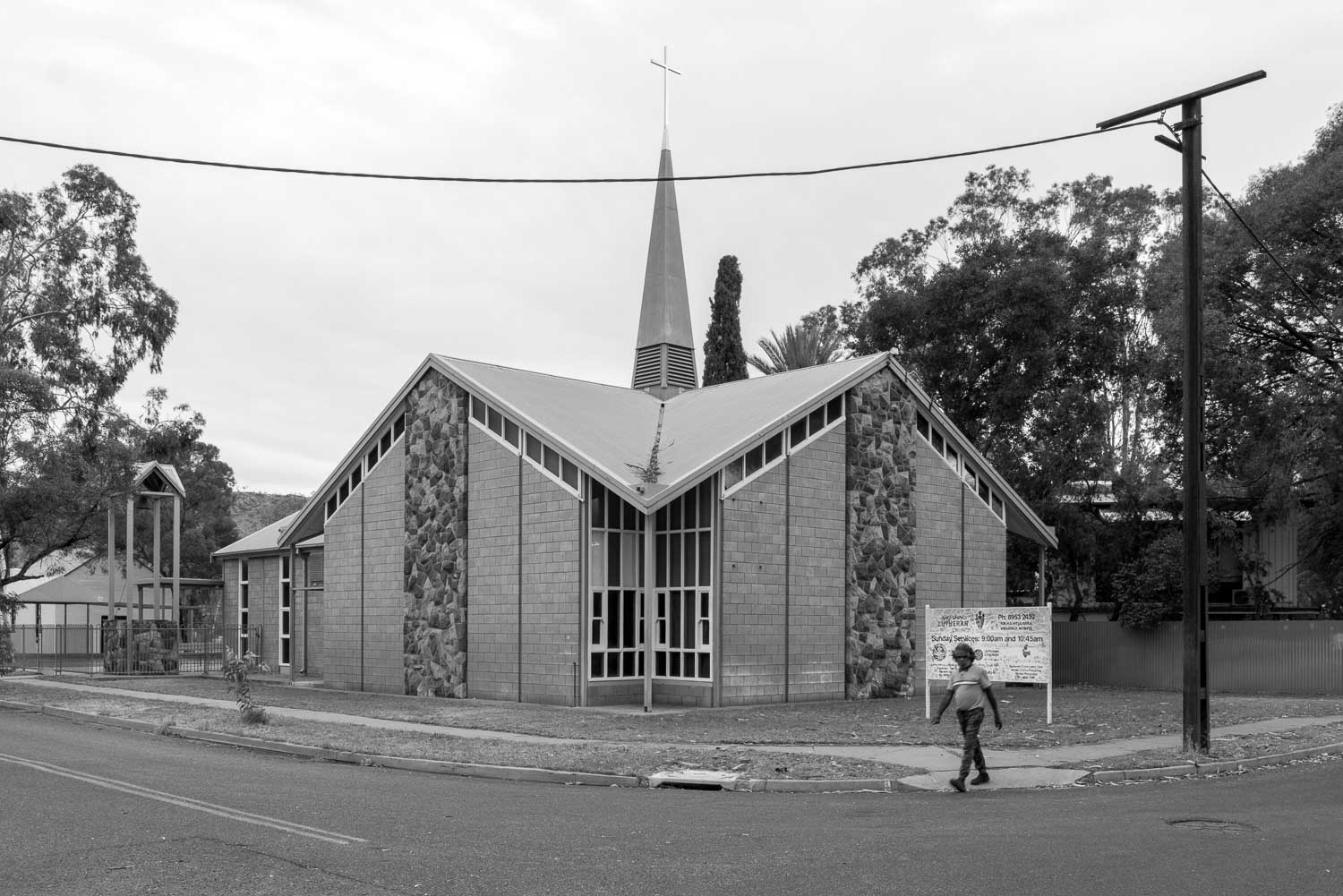
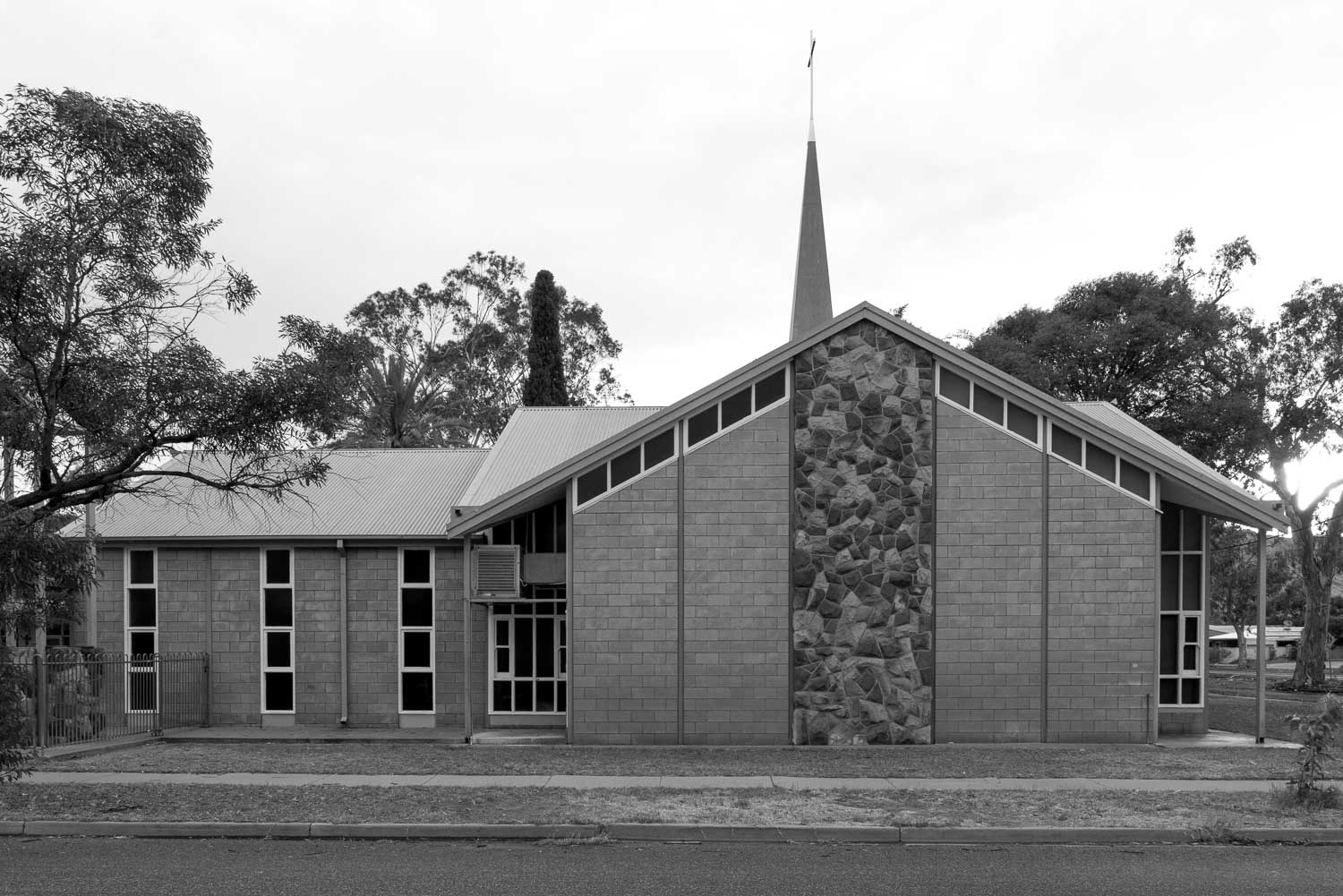


ALICE SPRINGS LUTHERAN CHURCH
49 GAP RD
ALICE SPRINGS NT 0870
PHOTOS: J MARLOW & NT LIBRARIES & ARCHIVE
49 GAP RD
ALICE SPRINGS NT 0870
PHOTOS: J MARLOW & NT LIBRARIES & ARCHIVE
The Lutheran Church at 49 Gap Road in Alice Springs, originally known as the Finke River Mission Church, was designed by Sir Eric von Schramek and dedicated by Pastor Paul Albrecht in 1967.
Von Schramek was one of Australia's most significant ecclesiastical architects of the twentieth century, and his involvement in Alice Springs was a natural extension of a career defined by church design.
Born in Prague in 1921 and trained at the Prague Technical University under the influence of Adolf Loos, a forerunner of the Bauhaus movement, he brought to his work a deep commitment to simplicity, honesty of structure and sobriety of form.
He had first come to the Northern Territory in 1948 as Senior Supervising Architect for the Commonwealth Department of Works and Housing, where he was involved in postwar reconstruction following the bombing of Darwin. He was later knighted in 1982 for services to architecture.
His ecclesiastical practice was prolific and ecumenical. Though strongly associated with the Lutheran Church, he designed churches for more than a dozen Methodist congregations across South Australia and undertook commissions in Victoria, New South Wales, Canberra, Papua New Guinea and the Northern Territory.
The Alice Springs Lutheran Church reflects his characteristic approach: a clean modernist design suited to the demands of a desert climate, with clarity of form and a restrained use of materials that allows the building to read as a coherent whole rather than a decorated object.
The Finke River Mission, for which the church was named, had been a Lutheran mission serving Arrernte people in central Australia since 1877, making the church a building with deep roots in both the European settlement of the region and the longer history of Aboriginal and Lutheran engagement in the Territory.
Heritage Status: Not Listed.
Von Schramek was one of Australia's most significant ecclesiastical architects of the twentieth century, and his involvement in Alice Springs was a natural extension of a career defined by church design.
Born in Prague in 1921 and trained at the Prague Technical University under the influence of Adolf Loos, a forerunner of the Bauhaus movement, he brought to his work a deep commitment to simplicity, honesty of structure and sobriety of form.
He had first come to the Northern Territory in 1948 as Senior Supervising Architect for the Commonwealth Department of Works and Housing, where he was involved in postwar reconstruction following the bombing of Darwin. He was later knighted in 1982 for services to architecture.
His ecclesiastical practice was prolific and ecumenical. Though strongly associated with the Lutheran Church, he designed churches for more than a dozen Methodist congregations across South Australia and undertook commissions in Victoria, New South Wales, Canberra, Papua New Guinea and the Northern Territory.
The Alice Springs Lutheran Church reflects his characteristic approach: a clean modernist design suited to the demands of a desert climate, with clarity of form and a restrained use of materials that allows the building to read as a coherent whole rather than a decorated object.
The Finke River Mission, for which the church was named, had been a Lutheran mission serving Arrernte people in central Australia since 1877, making the church a building with deep roots in both the European settlement of the region and the longer history of Aboriginal and Lutheran engagement in the Territory.
Heritage Status: Not Listed.